
Yoga for Digital Nomads: 3 Essential 15-Minute Flows to Erase Back Pain
Yoga for Digital Nomads: 3 Essential 15-Minute Flows to Erase Back Pain
The digital nomad lifestyle promises the ultimate freedom: swapping a dreary office cubicle for a laptop on a Bali beach or a bustling Lisbon café. But there’s a hidden cost to this freedom that few talk about—the persistent, nagging back pain. While competitors offer generic lists of yoga poses, they miss the reality of the nomad experience. You don’t need a list; you need a road-warrior’s survival guide. This isn’t just another article about stretching. This is your tactical playbook for bulletproofing your spine against the unique physical demands of a life in motion. We’ve created three distinct 15-minute “micro-flows” designed for the specific pain points of your day, turning any Airbnb floor or airport corner into your personal wellness studio. This is your system for sustaining the dream, one pain-free day at a time.
Why Your Wanderlust is Wrecking Your Back
The very things that make the digital nomad life exciting are often the primary sources of physical strain. Unlike a traditional office with ergonomic setups, your workspace is constantly changing, and rarely for the better. This inconsistency creates a perfect storm for chronic back, neck, and shoulder pain.
The Unholy Trinity: Awkward Chairs, Long Flights, and Heavy Backpacks
Your spine is under constant assault from three directions. First, the endless parade of ‘character-filled’ café chairs and unforgiving Airbnb stools force your body into unnatural positions, straining your lower back and hips. Second, long-haul flights or multi-hour bus rides compress your spine and tighten your hamstrings and hip flexors, key muscle groups that pull on the lower back. Finally, hoisting a backpack filled with your entire life’s tech and essentials puts direct, uneven pressure on your shoulders and spine. Over time, this trinity of stressors leads to inflammation, muscle imbalances, and persistent pain.
The Sneaky Culprit: “Tech Neck” and Posture Collapse
Hunching over a laptop for eight hours is bad enough. Hunching over a laptop that’s perched on a low coffee table is a recipe for disaster. This forward-head posture, often called “tech neck,” places immense strain on the cervical spine. For every inch your head juts forward, it adds an extra 10 pounds of weight for your neck and upper back muscles to support. This leads not only to neck and shoulder pain but also to headaches and reduced lung capacity. Without a consistent routine to counteract this postural collapse, pain becomes an inevitable travel companion.
More Than a Stretch: The Science of Yoga for a Resilient Spine
Yoga isn’t just about becoming more flexible; it’s a scientifically validated method for managing and preventing back pain. A landmark 2017 study published in the *Annals of Internal Medicine* found that a regular yoga practice was just as effective as physical therapy for reducing chronic lower back pain. But how does it work?
Yoga builds a foundation of support for your spine in three key ways. First, it strengthens your core muscles—the deep abdominal and back muscles that act as a natural corset, stabilizing your spine. Second, it increases flexibility in crucial areas like the hamstrings and hip flexors, which, when tight, can tilt the pelvis and strain the lower back. Finally, the deep breathing and mindful movement inherent in yoga help reduce cortisol levels and calm the nervous system, decreasing inflammation and the body’s perception of pain. Yoga Nidra: The Resilient ‘Non-Sleep Deep Rest’ Protocol for Beating Insomnia & Boosting Well-being
Your 15-Minute Nomad Yoga Toolkit: 3 Flows for Any Situation
The key to a sustainable practice on the road is to have the right tool for the right job. Instead of a one-size-fits-all routine, here are three targeted 15-minute flows designed for the specific challenges you face as a digital nomad. No mat required, just a few feet of floor space.
Flow 1: The “Post-Flight Reset” (For Arrival Day)
This sequence is designed to decompress your spine, open your tight hips, and restore blood flow after hours of being cramped in a seat.
- Cat-Cow (10 rounds): On hands and knees, inhale to drop your belly and look up (Cow), then exhale to round your spine and press the floor away (Cat). This mobilizes the spine and hydrates the vertebral discs.
- Downward-Facing Dog (5 deep breaths): From hands and knees, tuck your toes and lift your hips up and back. Pedal your feet to gently stretch your hamstrings and calves.
- Low Lunge (5 breaths per side): From Downward Dog, step your right foot between your hands and lower your left knee. Sink your hips forward to feel a deep stretch in the left hip flexor.
- Half Splits (5 breaths per side): From Low Lunge, shift your hips back and straighten your front leg, folding over it to stretch the hamstring.
- Supine Spinal Twist (5 breaths per side): Lie on your back, hug your knees to your chest, then drop both knees to the right as you gaze to the left. This gently releases tension in the lower back.
Flow 2: The “Café Chair Decompression” (Mid-Workday Break)
Use this quick, discreet flow to break up long work sessions and combat the dreaded “tech neck” and shoulder slump.
- Seated Cat-Cow (8 rounds): Sit at the edge of your chair, feet flat. Place hands on knees. Inhale to arch your back and look up; exhale to round your spine and drop your chin to your chest.
- Seated Eagle Arms (5 breaths per side): Extend your arms forward, cross the right arm over the left, bend the elbows, and bring the backs of your hands or palms to touch. Lift the elbows and press the forearms away to stretch the upper back and shoulders.
- Neck Rolls (3 rolls each direction): Gently drop your right ear to your right shoulder, then slowly roll your chin to your chest, over to the left shoulder, and back. Move slowly and mindfully.
- Chair-Assisted Forward Fold (5 breaths): Stand up, face your chair, and place your hands on the backrest. Walk your feet back until your body forms an L-shape, stretching your back and shoulders.
- Cross-Body Shoulder Stretch (30 seconds per side): Pull one arm across your chest, using the other arm to deepen the stretch.
Flow 3: The “End-of-Day Unwind” (For Deep Relaxation)
This restorative flow calms the nervous system, releases deep-seated tension, and prepares you for a restful night’s sleep.
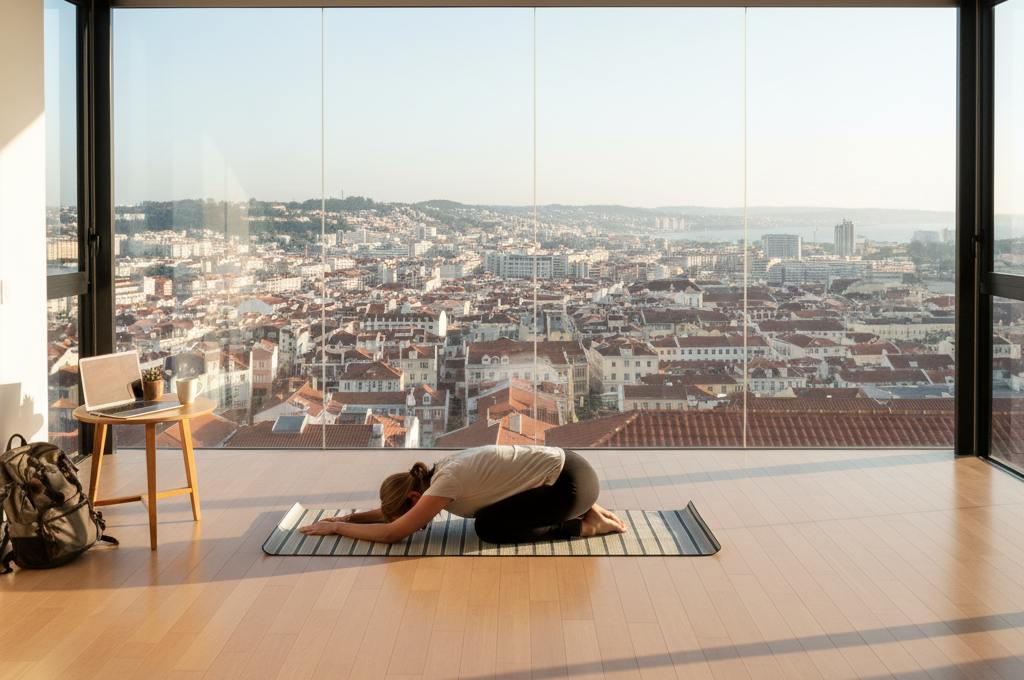
- Child’s Pose (10 deep breaths): Kneel on the floor, bring your big toes to touch, and sit back on your heels. Fold forward, resting your forehead on the floor. This is the ultimate pose for lower back release.
- Pigeon Pose (8 breaths per side): From hands and knees, bring your right knee to your right wrist and extend your left leg back. Fold forward over your front shin to release the deep glute and piriformis muscles, which can contribute to sciatic pain.
- Bridge Pose (3 rounds of 5 breaths): Lie on your back with knees bent and feet flat. Press into your feet to lift your hips. This strengthens the glutes and posterior chain, which supports the lower back.
- Legs-Up-The-Wall (2-3 minutes): The single best pose for nomads. Lie on your back and swing your legs up a wall. It reduces lower body inflammation, drains lymphatic fluid, and calms the mind.
Beyond the Mat: Pro-Tips for a Pain-Free Nomad Life
A 15-minute flow is powerful, but integrating smart habits throughout your day is what truly builds resilience.
Master Asynchronous Self-Care
Just like you manage your work across time zones, manage your self-care. Block out 15 minutes in your calendar for your yoga flow. It’s not an indulgence; it’s a critical task for your productivity. Attaching it to an existing habit—like right after your morning coffee or before you close your laptop for the day—makes it stick. How to Build a Morning Routine That Doesn’t Start with Your Phone: Reclaiming Your Day for True Well-being
Your “Anywhere” Prop: The Humble Towel
You don’t need fancy props. A rolled-up bath towel or a scarf can be a game-changer. Place it under your sit bones when in Child’s Pose for more comfort, or use it as a strap to deepen a hamstring stretch. It can also be rolled and placed behind your lower back for lumbar support in any chair.
Ergonomic Hacks for the Road
Small adjustments make a huge difference. Invest in a lightweight, portable laptop stand to bring your screen to eye level. This is the single most effective way to prevent tech neck. Use packing cubes or a small pillow for lumbar support on planes and in cafes. When choosing your workspace, look for tables that allow your elbows to be at a 90-degree angle.
Conclusion: Build a Body That Can Sustain Your Dreams
The digital nomad life is a marathon, not a sprint. While others burn out from the physical and mental strain, you can thrive by implementing a smart, sustainable system for self-care. This isn’t about becoming a master yogi; it’s about reclaiming your physical autonomy. By integrating these targeted 15-minute flows into your routine, you’re not just alleviating back pain—you’re investing in the longevity of your dream lifestyle. You’re building a body that is as resilient, adaptable, and free as you are.